|
Size: 4737
Comment:
|
Size: 4547
Comment:
|
| Deletions are marked like this. | Additions are marked like this. |
| Line 9: | Line 9: |
| [http://www.cse.unsw.edu.au/~richardb/images/overview.png] | {{attachment:overview.png}} |
| Line 15: | Line 15: |
| [http://www.cse.unsw.edu.au/~richardb/images/start.png] | {{attachment:start.png}} |
| Line 17: | Line 17: |
| === ENGG1811 === * Students mainly interested in ''using'' computers as tools to solve problems, particularly engineering problems, should select the general level course ENGG1811. This course focuses on using well known computer software packages to solve problems. It also has a small programming component. * If you have a particular interest in computing, in programming, or any background in computing or programming you should consider taking COMP1911 or COMP1917 instead (see below). * Electrical Engineers and students undertaking degrees in computing should take COMP1911 or COMP1917 instead (see below). === COMP1911 === * This course provides an introduction to programming. It assumes no background programming experience. It concentrates on developing programming skills and how to think like a programmer. At the end of this course you will be able to write test and debug simple programmes in the language C. * If you have experience in programming, or good marks in mathematics or science, or an interest in computing you should consider taking COMP1917 instead (see below). * Students undertaking degrees in computing degrees are permitted to take this course, but we strongly suggest you take COMP1917 instead (see below). |
|
| Line 32: | Line 23: |
| * Students may change freely between this course and comp1911 for the first few weeks of semester (subject to the course not being full), so feel free to try the course and see how you find it. * We recommend computing students take this course rather than COMP1911, otherwise you will need to take an additional course in order to fulfill your first year requirements. |
* Students may change freely between this course and comp1911 for the first two weeks of semester (subject to the course not being full), so feel free to try the course and see how you find it. * Computing major students should take this course rather than COMP1911, otherwise you will need to take an additional course in order to fulfil your first year requirements and possibly have problems completing your degree in time. === COMP1911 === * This course provides an slower introduction to programming. Like 1917 it assumes no background programming experience. It concentrates on developing programming skills and how to think like a programmer. At the end of this course you will be able to write test and debug simple programmes in the language C. * If you have experience in programming, or good marks in mathematics or science, or an interest in computing you should consider taking COMP1917 instead (see above). === ENGG1811 === * Students mainly interested in ''using'' computers as tools to solve problems, particularly engineering problems, should select the general level course ENGG1811. This course focuses on using well known computer software packages to solve problems. It also has a small programming component. * If you have a particular interest in computing, in programming, or any background in computing or programming you should consider taking COMP1917 or COMP1911 instead (see above). * Electrical Engineers and students undertaking degrees in computing should take COMP1917 or COMP1911 instead (see above). |
| Line 37: | Line 38: |
| === Higher Stream === | === Standard Computing Stream === |
| Line 39: | Line 40: |
| Most computing students, about half the electrical engineering students, and any other students with an interest in computing take this stream. After two courses you are qualified to take some computing minors, or to proceed to COMP2911 and take any computing major. | Most computing students, about half the electrical engineering students, and any other students with an interest in computing take this stream. After two courses students are qualified to take some computing minors, or to proceed to COMP2911 and take any computing major. |
| Line 41: | Line 42: |
| [http://www.cse.unsw.edu.au/~richardb/images/stream-higher.png] | {{attachment:stream-higher.png}} |
| Line 45: | Line 46: |
| For students who would like to or need to learn C programming but don't have a particular interest in computing. About half the electrical engineering students, and any other students who would like to learn programming at a more gentle pace take this stream. After two courses you are qualified to take some computing minors, or to proceed to COMP1927 and COMP2911 and take any computing major. | For students who would like to or need to learn C programming but don't have a particular interest in computing. About half the electrical engineering students, and some other students who would like to learn programming at a more gentle pace take this stream. After two courses students are qualified to take some computing minors, or to proceed to COMP1927 and COMP2911 and take any computing major. |
| Line 47: | Line 48: |
| [http://www.cse.unsw.edu.au/~richardb/images/stream-general.png] | {{attachment:stream-general.png}} |
| Line 54: | Line 55: |
| * After this course you can learn more about programming in COMP1911 if you wish. You may also continue to take further computing courses after COMP1911, or take COMP1917 instead of COMP1911 - however if you are considering doing this you should probably save time and start with COMP1911 or COMP1917 rather than ENGG1811. * Electrical Engineering students and students doing degrees in computing should not take the ENGG1811 stream. They start with COMP1911 or 1917. |
* After this course students can learn more about programming in COMP1911 if they wish. Students may also continue to take further computing courses after COMP1911, or take COMP1917 instead of COMP1911 - however if students are considering doing this they should probably save time and start with COMP1911 or COMP1917 rather than ENGG1811. * Electrical Engineering students and students doing degrees in computing should NOT take the ENGG1811 stream. They start with COMP1911 or 1917. |
| Line 58: | Line 59: |
| [http://www.cse.unsw.edu.au/~richardb/images/stream-engineers.png] | {{attachment:stream-engineers.png}} |
Paths through the courses
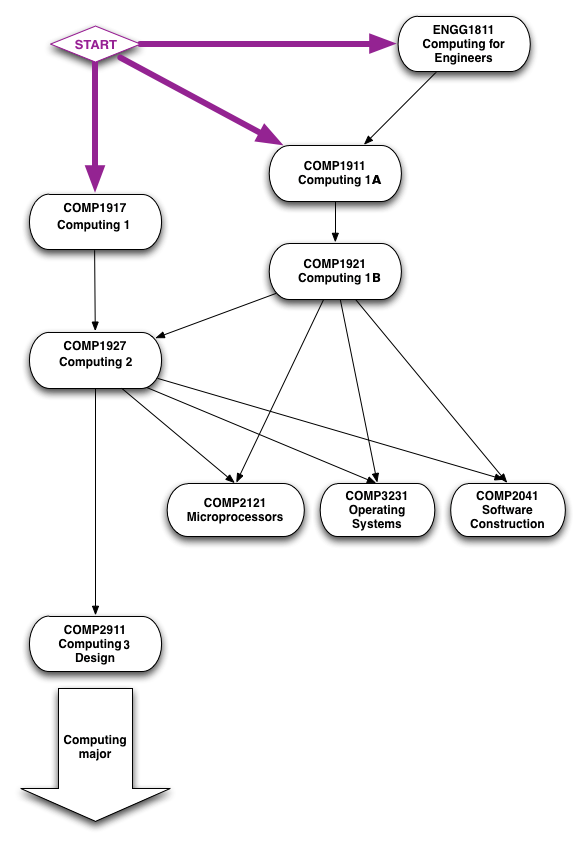
Overview
Here are all three of the first year computing streams on a single map.
The first course
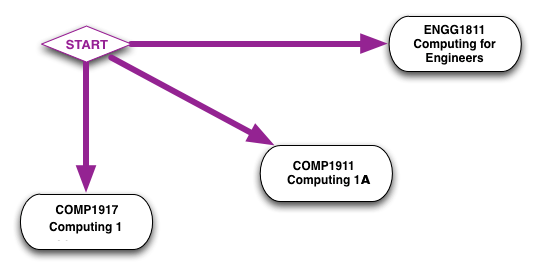
Students select between one of three courses depending on which of the three streams they are taking.
COMP1917
- This course provides an introduction to programming and computer science. Like COMP1911 it assumes no background programming experience. It concentrates on developing professional programming and analytical skills, and how to think like a computer scientist/computer engineer/software engineer. At the end of this course you will be able to write test and debug simple and intermediate level programmes.
- This course is harder and more work than COMP1911. It should also be more interesting and fun.
- You should select between 1911 and 1917 based on interest not based in prior programming experience.
- Don't worry if you have no programming experience, about 2/3 of the class will have no prior programming experience. If you have prior programming experience you'll probably find the first few weeks a bit more easy - but don't get too complacent, past results indicate that students with no prior programming experience end up performing as well on average as students who have prior experience.
- Students may change freely between this course and comp1911 for the first two weeks of semester (subject to the course not being full), so feel free to try the course and see how you find it.
- Computing major students should take this course rather than COMP1911, otherwise you will need to take an additional course in order to fulfil your first year requirements and possibly have problems completing your degree in time.
COMP1911
- This course provides an slower introduction to programming. Like 1917 it assumes no background programming experience. It concentrates on developing programming skills and how to think like a programmer. At the end of this course you will be able to write test and debug simple programmes in the language C.
- If you have experience in programming, or good marks in mathematics or science, or an interest in computing you should consider taking COMP1917 instead (see above).
ENGG1811
Students mainly interested in using computers as tools to solve problems, particularly engineering problems, should select the general level course ENGG1811. This course focuses on using well known computer software packages to solve problems. It also has a small programming component.
- If you have a particular interest in computing, in programming, or any background in computing or programming you should consider taking COMP1917 or COMP1911 instead (see above).
- Electrical Engineers and students undertaking degrees in computing should take COMP1917 or COMP1911 instead (see above).
Streams
Standard Computing Stream
Most computing students, about half the electrical engineering students, and any other students with an interest in computing take this stream. After two courses students are qualified to take some computing minors, or to proceed to COMP2911 and take any computing major.
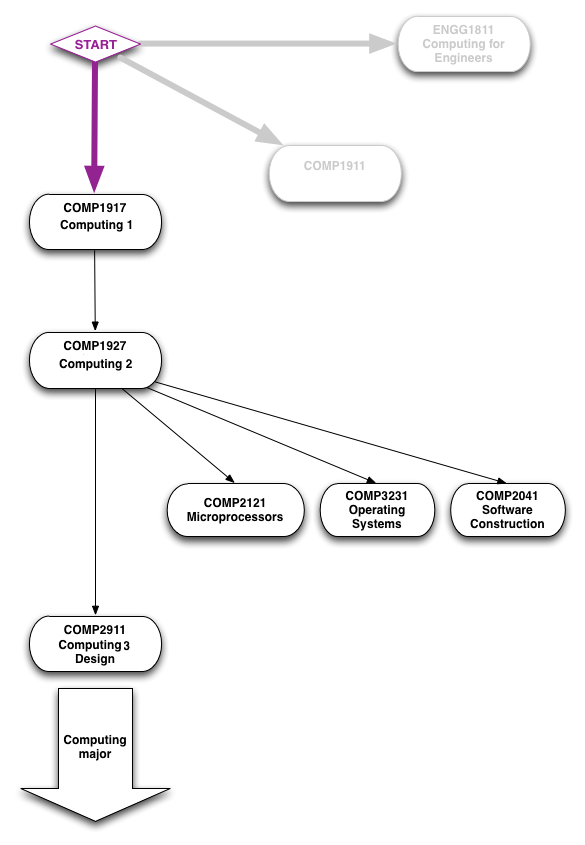
General Stream
For students who would like to or need to learn C programming but don't have a particular interest in computing. About half the electrical engineering students, and some other students who would like to learn programming at a more gentle pace take this stream. After two courses students are qualified to take some computing minors, or to proceed to COMP1927 and COMP2911 and take any computing major.
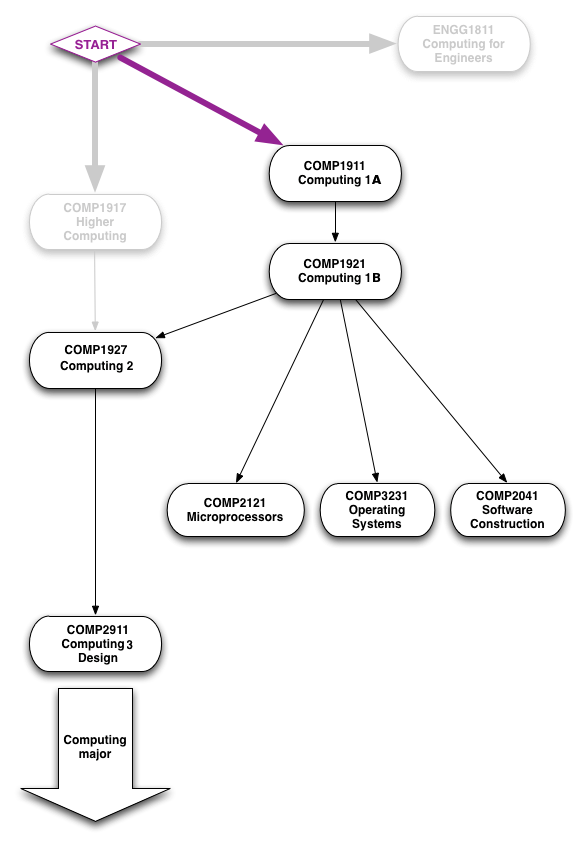
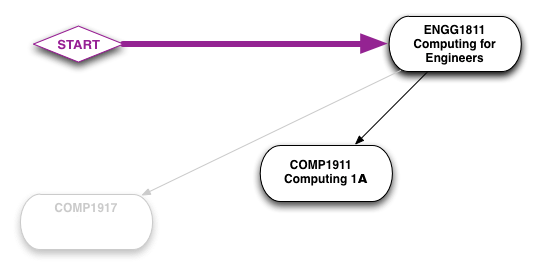
Computing for Engineers Stream
For students who want to learn how to used computer programs to solve problems, but aren't so interested in learning how to write computer programs or design new computing technology.
- After this course students can learn more about programming in COMP1911 if they wish. Students may also continue to take further computing courses after COMP1911, or take COMP1917 instead of COMP1911 - however if students are considering doing this they should probably save time and start with COMP1911 or COMP1917 rather than ENGG1811.
- Electrical Engineering students and students doing degrees in computing should NOT take the ENGG1811 stream. They start with COMP1911 or 1917.